Forethought, Afterthought, and the Trap of Passive Hope
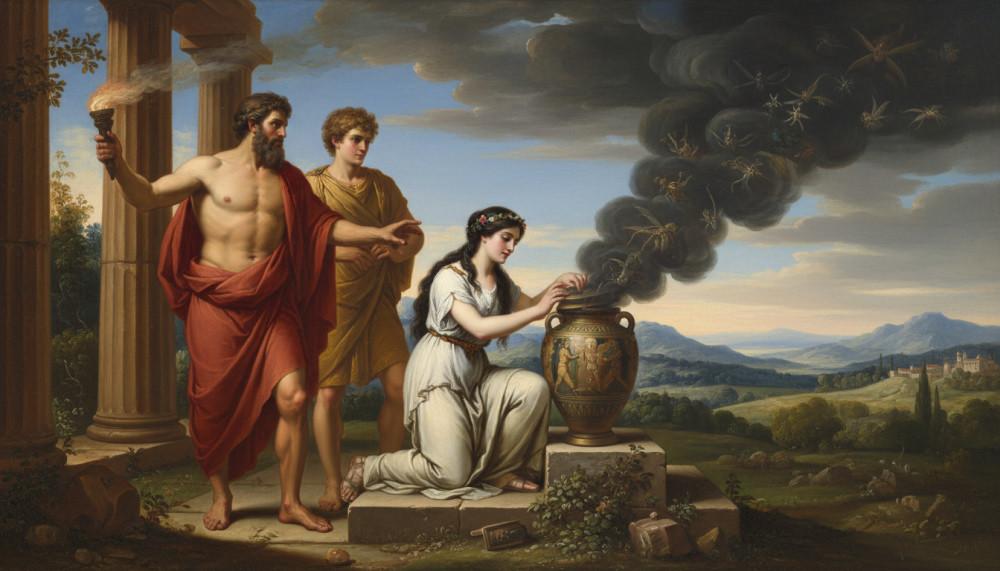
To live in alignment with the Logos—the divine ordering principle of truth—requires a rigorous devotion to cause and effect. It demands that we look at reality not as we wish it to be, but as it objectively is. However, the human mind is frequently divided between two modes of being: the active will of the planner and the passive reaction of the victim. This dichotomy is not new; it is ancient, encoded in the very roots of our mythology. When we examine the state of modern consciousness, we find that a vast majority have abandoned the clarity of self-mastery for a seductive, intoxicating opiate. That opiate is hope, and to understand its treacherous nature, we must return to the jar of Pandora.
Abductive reasoning is a form of logical inference that starts with observations and seeks the simplest, most likely explanation, embracing uncertainty and iteration. It thrives on generating and refining hypotheses, often leading to surprising yet plausible conclusions, as seen in Sherlock Holmes’ investigative approach.
The myth tells of two Titan brothers entrusted with the creation and preservation of mankind: Prometheus, whose name signifies “forethought,” and Epimetheus, meaning “afterthought.” Prometheus, defying the tyrant god Zeus, stole fire from the heavens to give humanity agency, technology, and civilization. Yet, this fire represented more than mere survival; it was the theft of Reason itself—specifically the creative power of abductive reasoning. This divine spark gave man the capacity to leap beyond rote observation, to infer hidden causes, and to conceptually construct a future before it manifests. In retaliation for this empowerment, Zeus devised a trap. He commissioned the creation of Pandora, the first woman, endowed with seductive gifts by the gods, and sent her not to the sharp-minded Prometheus—who saw the trap coming and refused the gift—but to the dull-witted Epimetheus.
Epimetheus, blinded by surface beauty and lacking the foresight to see consequences, accepted her. She brought with her a jar (pithos)—mistranslated later as a box—containing all the spites and plagues of the world. When the lid was lifted, sickness, turmoil, and strife escaped to afflict humanity. Only one entity remained trapped inside the rim when the lid was slammed shut: Hope (Elpis). For centuries, romantics have interpreted this ending as a mercy, believing that hope was preserved to comfort humanity in its suffering. However, through the lens of the Logocentric worldview, which prioritizes objective truth over subjective comfort, a darker reality emerges.
Why was hope contained in a jar filled exclusively with evils? The answer is that hope, in this context, is not a virtue; it is the final plague. It is the suspension of action. While the other evils fly out and attack the body or the environment, hope attacks the will. It is the mechanism by which those who lack forethought endure their slavery, waiting for a salvation that will never come, rather than seizing the fire of agency to free themselves. It negates the creative reason Prometheus gifted us; instead of using abductive logic to solve problems, the hopeful man simply waits for the problem to solve itself.
This distinction between the brothers is the defining struggle of the moral life. Prometheus represents the Logocentric ideal: the recognition of natural law. He understands that actions have consequences, that causes precede effects, and that survival depends on knowing rather than wishing. Forethought is the faculty of self-ownership; it looks at the trajectory of the present to alter the future. Epimetheus, conversely, represents the chaotic, reactionary mind. He acts on impulse, ignores warnings, and only understands reality after the damage is done. He is the archetype of the victim, forever asking, “Why is this happening to me?” rather than “What did I do to cause this?”
Those trapped in the mindset of afterthought use hope as a narcotic to numb the pain of their own incompetence. When one possesses forethought, one does not need to “hope” that things turn out okay; one exerts the Will to ensure they do. A farmer who understands the seasons and the soil does not sit on his porch hoping for a harvest; he plants, he waters, and he protects his crop. He operates within the realm of causality. The man of afterthought, having failed to plant in the spring, is left with nothing but the hope that food will miraculously appear in the fall. In this sense, hope is the refuge of those who have refused to align themselves with the truth of natural law.
This dynamic is perfectly illuminated by what philosopher Ken Wilber termed the “Pre/Trans Fallacy.” As explored in my article on the logic of envy and control, this fallacy occurs when pre-rational states (childish impulsivity, magical thinking, lack of boundaries) are confused with trans-rational states (spiritual enlightenment, genuine faith, transcendence). The Epimethean man believes his hope is a spiritual virtue—a “trans-rational” trust in the universe. In reality, it is a “pre-rational” regression. He has not transcended the need for control and logic; he has failed to achieve it in the first place. He is not a mystic trusting God; he is a child refusing to clean his room, hoping his mother will do it for him.
By substituting hope for self-control, the individual abdicates self-mastery. True sovereignty requires the rigorous application of the Will against the resistance of the world. It requires the Logocentric discipline of aligning one’s internal map with the external territory of reality. When we rely on hope, we are essentially writing bad checks against reality, expecting the laws of the universe to bend because we desire a positive outcome. This is an attempt to control the outcome without mastering the process. It is the logic of the gambler who hopes for a winning hand to solve his financial ruin, rather than the logic of the disciplined creator who builds wealth through value creation.
This passive hope creates a spiritual vacuum. If God is truth (Logos), then honoring God requires honoring the mechanisms of truth—specifically, cause and effect. To sit in the debris of one’s bad decisions and “hope” for a better future is to demand that truth contradict itself. It is an act of spiritual cowardice. It denies the reality of the present moment and rejects the responsibility of the self to act as a co-creator within the divine order. The Epimethean mind waits for a savior; the Promethean mind realizes that the spark of the divine—the fire of creative reason—is already in his hands, waiting to be used.
Ultimately, the jar of Pandora serves as a container for our projected impotence. As long as we keep the lid down and cherish the hope inside, we remain in a state of afterthought, perpetually reacting to a world we refuse to understand. We barter our agency for the comfort of a delusion. We trade the hard work of self-ownership for the sweet, paralyzing thought that “everything happens for a reason,” ignoring that often, the reason is our own lack of foresight and discipline. To escape the cycle of the jar, we must kill the Epimetheus within us. We must reject the seductive comfort of passive hope and embrace the terrifying responsibility of forethought. Leave hope in the jar—it belongs with the plagues. Take the fire instead.
Did you enjoy the article? Show your appreciation and buy me a coffee:
Bitcoin: bc1qmevs7evjxx2f3asapytt8jv8vt0et5q0tkct32
Doge: DBLkU7R4fd9VsMKimi7X8EtMnDJPUdnWrZ
XRP: r4pwVyTu2UwpcM7ZXavt98AgFXRLre52aj
MATIC: 0xEf62e7C4Eaf72504de70f28CDf43D1b382c8263F
THE UNITY PROCESS: I’ve created an integrative methodology called the Unity Process, which combines the philosophy of Natural Law, the Trivium Method, Socratic Questioning, Jungian shadow work, and Meridian Tapping—into an easy to use system that allows people to process their emotional upsets, work through trauma, correct poor thinking, discover meaning, set healthy boundaries, refine their viewpoints, and to achieve a positive focus. Read my philosophical treatise, “The Logocentric Christian”, to learn more about how Greek philosophy, the law of identity, the law of non-contradiction, the law of reason, and Jesus of Nazareth all connect together.

One Response to “Pandora’s Jar and the Curse of Hope”
Read below or add a comment...
Trackbacks
[…] my previous examination of Pandora’s Jar, I dismantled the deceptive comfort of hope, exposing it as a passive tether that binds us to the […]