From Edenic Authority to Prussian Classrooms, the Battle for Rational Freedom.
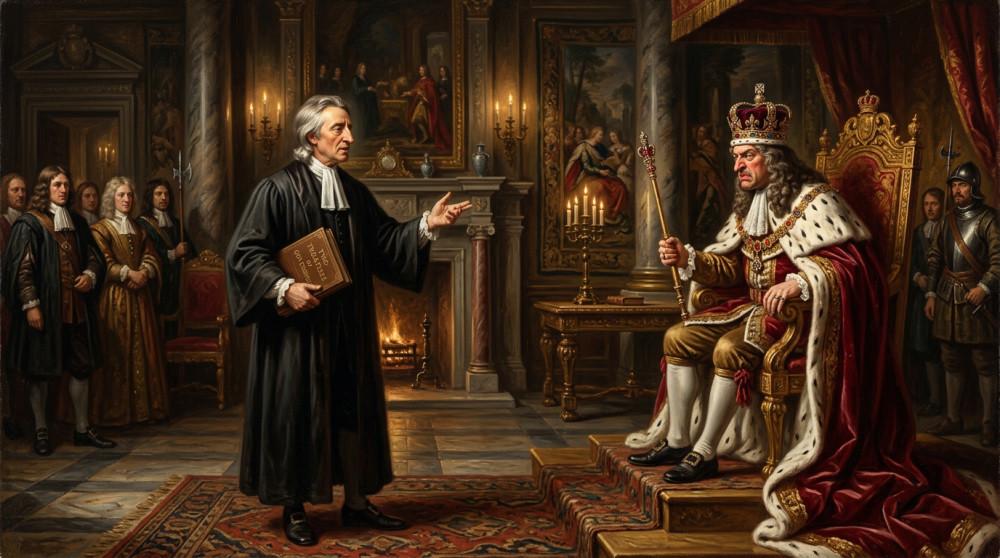
The publication of John Locke’s “Two Treatises of Government” stands as a definitive philosophical dismantling of political tyranny. Written against a backdrop of absolute monarchy, Locke’s work sought to eradicate the justifications used by potentates to subjugate the individual. The primary target of his intellectual assault was the “divine right of kings,” a doctrine that sought to legitimize absolute power by framing the relationship between a monarch and his subjects as one inherently ordained by God. Locke recognized this framework as a profound contradiction to natural law, setting out to prove that sovereign authority resides not in a crown, but within the self-governing individual who aligns with objective truth.
To understand Locke’s refutation, one must first clearly define the specific “divine right” argument he was combating. Popularized by thinkers like Robert Filmer, this doctrine was intimately tied to a patriarchal view of humanity, tracing absolute royal authority all the way back to the Garden of Eden. The argument posited that Adam possessed a divinely granted, absolute dominion over his children, and that this paternal authority was inherited exclusively by the royal lines of subsequent kings. Consequently, the monarchs viewed their entire populations as perpetual children, claiming the precise same unquestionable authority over their subjects that a father holds over a newly born infant.
Locke identified a fundamental flaw in this patriarchal model of statehood. He firmly separated the temporary authority of a parent from the permanent authority claimed by a political monarch over an adult populace. Locke’s essential counterargument was remarkably straightforward yet revolutionary: while a parent certainly has localized authority over a child, the state cannot assert that same authority over an adult individual. He essentially declared, “Sure, you possess authority over an infant, but if I am no longer a child, you cannot rule me.” By shifting the unit of analysis to the mature individual, Locke exposed the assertion that a nation is merely a kingdom of permanent children as a manipulative contradiction.
John Locke’s law of reason refers to the natural capacity of human beings to use rational thought to discern moral and ethical principles that govern just interactions, independent of external authority. It is an internal guide, accessible through reflection, that aligns individual actions with objective truths about reality and human rights.
Central to dismantling this royal overreach is Locke’s conceptualization of the “law of reason.” This law is deeply synonymous with the Logos—the objective, universal truth that continually governs the natural world and dictates moral order. According to Locke, the law of reason teaches that all mankind is naturally equal and independent, meaning no earthly authority has the right to arbitrarily infringe upon another’s life, liberty, or possessions. A self-governing individual who thinks and acts in harmony with this universal law requires no earthly monarch to dictate their morality, as they are guided internally by the self-evident truths established by the Creator.
However, Locke acknowledged the biological and developmental reality of childhood, conceding that children are not born fully subject to this law. At birth, humans fundamentally lack the cognitive maturity and discerning faculties necessary to process the complexities of the world around them. Because an infant lacks the capacity to internally govern their own actions according to the Logos, they must be externally governed for their own safety, preservation, and upward development. Therefore, the natural authority a parent holds over a child is not a mandate for tyrannical control, but rather a functional mechanism necessitated by the child’s temporary state of ignorance.
Consequently, Locke’s arguments regarding parenting frame the raising of children as a sacred, temporary stewardship rather than an exercise in lifelong dominion. The primary responsibility of the parent is to systematically nurture the child’s mind, protecting them while actively teaching them how to process reality. Parents are specifically tasked with cultivating the child’s intellect and morality, purposefully guiding them away from dependency and towards rational self-sufficiency. The overarching goal of this parental governance is to literally govern the child explicitly until the child becomes fully capable of governing themselves.
John Locke’s age of reason refers to the developmental stage when an individual gains the capacity for rational thought and self-governance, marking their emancipation from parental authority, as outlined in his Two Treatises of Government. This milestone, typically emerging in adolescence around the mid-to-late teens, enables individuals to make independent, reasoned decisions, distinguishing human adulthood from mere biological maturity, though Locke emphasizes individual development over a fixed age.
This developmental journey inevitably culminates in what Locke termed the age of reason. Reaching this age is not merely about achieving a specific numerical birthday, but rather arriving at a cognitive milestone where the individual has developed the mental fortitude to understand and live by the law of reason independently. When an individual achieves this cognitive capacity, they boldly transition from a dependent entity into a fully realized, sovereign individual. At this exact point of rational maturation, the natural justification for parental authority completely expires, and the individual steps perfectly into their innate right to liberty.
The mechanics of this transition can be understood clearly through a precise cognitive formula: Knowledge + Understanding – Contradictions = Wisdom (Truth). A parent’s highest duty is to supply the child with accurate knowledge and help them build understanding, meticulously identifying and removing behavioral and logical contradictions in their worldview. As the child progressively resolves these contradictions, they acquire the practical wisdom necessary to align with truth. Once this internal cognitive architecture is firmly established, any external attempt by a king or state to bypass the individual’s mind and artificially reimpose a parent-child dynamic becomes profoundly illegitimate and structurally unsound.
The contrast between the self-governing individual and the monarchist viewpoint represents an irreconcilable clash of paradigms. The divine right of kings relies heavily on artificially arresting the intellectual and spiritual development of the individual, demanding lifelong submission and blind obedience to a fellow mortal. In stark contrast, a framework rooted in the Logos demands that each individual assumes ultimate responsibility for their own life, critically examining their own thinking, feelings, and behaviors. True societal order is therefore created not by an all-powerful sovereign treating citizens as subjects, but by a network of independent individuals voluntarily acting in accordance with the law of reason.
Despite Locke’s philosophical victory, the desire to rule over a populace of perpetual children did not vanish; it simply metamorphosed. Rather than relying on the theological assertions of the divine right of kings, the modern state sought to maintain a parent-child dynamic through the monopolization of schooling. Beginning in the nineteenth century, American central planners imported the Prussian educational system, a model specifically designed not to foster independent thought, but to guarantee obedience to the state. By institutionalizing the developing mind, the state found a highly effective mechanism to artificially arrest the intellectual development of the individual. The unspoken objective of this compulsory systemic design was to ensure that the average citizen never truly reaches the age of reason, keeping them dependent on external authority instead of their own internal rational faculties.
The liberal arts are the foundational intellectual disciplines—centered fundamentally on logic, grammar, and rhetoric—specifically designed to liberate the sovereign individual by providing the analytical faculties required for rational self-governance. A classical education is the systematic pedagogical framework that effectively delivers these arts, purposefully guiding the developing mind to align with the Logos by meticulously removing cognitive contradictions to arrive at objective Wisdom (Truth).
Sophrosyne is the Greek classical virtue of rational temperance and moral soundness that empowers a sovereign individual to actively govern their own mind and behavior in perfect alignment with the Logos, effectively replacing the need for external state coercion and laws with steadfast, internal self-responsibility.
To achieve this arrested development, the traditional pillars of learning were systematically dismantled. Logic, the broader liberal arts, and the classical cultivation of sophrosyne—the virtue of temperance, self-responsibility, and rational self-government—were largely removed from the public curriculum. In their place, the state instituted rote, didactic instruction, prioritizing memorization and behavioral compliance over the identification and elimination of cognitive contradictions. As the celebrated educator and author John Taylor Gatto extensively documented, this shift was not accidental but structural; the modern schooling system was engineered to manufacture lifelong childishness. By depriving the individual of the tools required to process reality and synthesize wisdom, the state effectively reinstates the very condition of intellectual infancy that Locke argued must be fundamentally outgrown.
The overtly elitist mindset driving this educational paradigm was unabashedly championed by progressive leaders who sought to engineer a compliant workforce rather than a society of self-governing peers. In a 1909 address, Woodrow Wilson explicitly outlined this bifurcated vision for America, stating: “We want one class of persons to have a liberal [arts] education, and we want another class of persons, a very much larger class, of necessity, in every society, to forego the privileges of a liberal [arts] education… to make skillful servants of society along mechanical lines.” This managerial philosophy serves as a direct, modern resurrection of the patriarchal monarchist worldview. It relies completely on subverting the cognitive maturation of the individual, ensuring the vast majority remain intellectually subordinate to a centralized state acting as an eternal surrogate parent.
The false equivalence fallacy is a deceptive cognitive contradiction that illogically asserts two fundamentally different subjects are equal based entirely on a superficial shared characteristic, thereby distorting reality and preventing the individual from discerning objective truth. It is sometimes called “comparing apples to oranges.”
In his “Two Treatises of Government”, John Locke successfully eradicated the grand conceptual illusion of the patriarchal monarch, yet his philosophical framework remains profoundly relevant against the overreach of the modern state. By destroying the false equivalency between localized paternal duty and sweeping political tyranny, he reclaimed the inherent dignity of the autonomous adult individual against any system—royal or educational—that demands perpetual infantilization. He demonstrated powerfully that while childhood necessitates temporary external guidance, true maturity demands a steadfast, internal commitment to objective truth. Ultimately, mankind is not a collective nursery to be managed by royal decree or state curriculum, but a living fellowship of sovereign individuals originally designed to govern themselves through the eternal law of reason.
Did you enjoy the article? Show your appreciation and buy me a coffee:
Bitcoin: bc1qmevs7evjxx2f3asapytt8jv8vt0et5q0tkct32
Doge: DBLkU7R4fd9VsMKimi7X8EtMnDJPUdnWrZ
XRP: r4pwVyTu2UwpcM7ZXavt98AgFXRLre52aj
POL: 0xEf62e7C4Eaf72504de70f28CDf43D1b382c8263F
THE UNITY PROCESS: I’ve created an integrative methodology called the Unity Process, which combines the philosophy of Natural Law, the Trivium Method, Socratic Questioning, Jungian shadow work, and Meridian Tapping—into an easy to use system that allows people to process their emotional upsets, work through trauma, correct poor thinking, discover meaning, set healthy boundaries, refine their viewpoints, and to achieve a positive focus. Read my philosophical treatise, “The Logocentric Christian”, to learn more about how Greek philosophy, the law of identity, the law of non-contradiction, the law of reason, and Jesus of Nazareth all connect together.
