Churches as sovereign nations: bound by truth, free in custom.
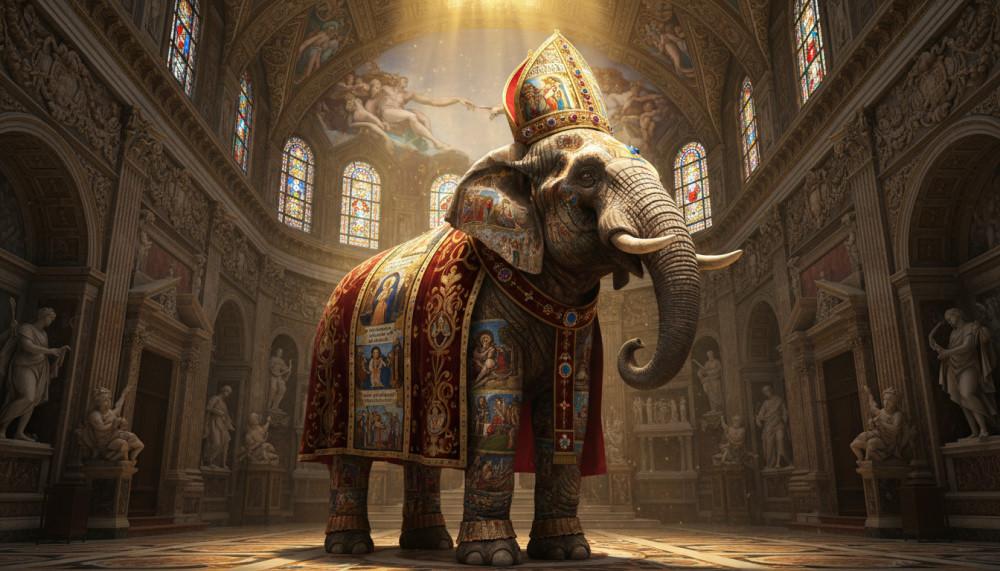
The historical and theological lineage of the western church, particularly the Catholic church, offers a fascinating case study in the relationship between truth and tradition. Theoretically, Rome stands as a unique extension of Athens in the mythology and philosophy of the West, absorbing the Greek understanding of the Logos while holding a direct historical link to the apostles and their missionary journeys. This integration is most visibly exemplified by Thomas Aquinas, who leaned upon Aristotle to develop the foundation of natural law. This lineage of objective truth did not stop at the church doors; it rippled through history, influencing the philosophy of John Locke, eventually culminating in the US Declaration of Independence and the US Constitution. Thus, the church acted as a bridge, carrying the torch of reason and rights across centuries.
In this ideal sense, the church is not merely a religious institution but a vessel for the universal reason that undergirds reality, a reality explored deeply by the mystics. For example, St. John of the Cross and the Carmelite tradition provided profound psychological insights into the human condition, detailing the “dark night of the senses” and the “dark night of the soul” on the path to the divine marriage. These contributions have deeply affected both psychology and religion, proving that the institution was capable of recognizing and housing deep truth. Without a foundation in the Logos—the divine logic and ordering principle of the universe—such greats would not have been listened to, nor would their contributions have been accepted into the body of Catholicism. Consequently, if a church or denomination is truly founded on the Logos, there should be a natural, resonant harmony between any Logocentric individual and the institutional church, as they share the same bedrock: a commitment to objective truth, natural law, and the divine nature of Christ.
As rhetorical devices from Greek philosophy, ethos establishes credibility through authority and character, pathos persuades through emotional resonance, and logos convinces through an appeal to reason and objective truth. While a society founded on Logos would demand that ethos be built upon sound reason, our inverted world sees a credential-based ethos weaponize pathos to manipulate the public, thereby supplanting logos and therefore reality itself.
However, to understand why friction often arises in practice, one must revisit the fundamental hierarchy of value: the distinction between logos and ethos as rhetorical devices. Logos is the “what” and the “why”—it is the truth itself, immutable and universal. Ethos is the “how”—the authority, customs, traditions, hierarchies, and cultural flavors developed to express that truth. In a healthy system, ethos serves logos; tradition acts as a vehicle to transport the individual toward the truth. The problem arises when this hierarchy is inverted, a phenomenon described as the “anti-christ” spirit, where the vessel is worshiped rather than the contents, and consensus is valued over reality.
This dynamic is not exclusive to Catholicism; it permeates Protestantism and Evangelicalism as well. In a previous article I discussed how nations can be sovereign cultural flavors, I argued that we do not need competing ethoi to destroy one another if the foundation is the Logos. Just as distinct cultures can be linked through truth while maintaining distinct customs, religious traditions should operate similarly. Whether one is in a high-church liturgical setting or a low-church evangelical gathering, the ethos should just be a “flavor” of the common foundation. They do not need to merge their traditions; they simply need to recognize the same foundational truth in one another’s eyes.
Yet, a significant barrier exists in the modern landscape. We live in an era where the “appeal to authority” fallacy has become a dominant cognitive default. It is a reality of the times that many people, regardless of their specific denomination, have been conditioned to look for external validation rather than internal alignment with Logocentric reality. This societal conditioning bleeds into churches, leading many adherents to connect to their institution as an authority for the sake of it being an authority. They value the authority and tradition more than the truth, inadvertently turning their faith into a power game rather than a truth game.
For the Logocentric individual—someone who has developed a philosophy derived directly from universal truths, natural law, humility, empathy, and courage, or who was raised in a church setting where Logos reigns supreme—this creates a complex dynamic. This individual cherishes spiritual community and/or spiritual sovereignty and their connection to the Logos. When interacting with someone deeply entrenched in the ethos of a different flavor, whether Catholic or Protestant, the friction is often palpable. The Logocentric person would rightly be wary of any system that might demand the abandonment of reason to submit to a collective consensus that may have drifted from its foundational purpose.
This is where the distinction between true hierarchy and false hierarchy becomes essential. A true hierarchy places logos at the top, with ethos stemming from and serving it. A false hierarchy places the ethos—the tradition, the pastor, the doctrine, the magisterium—at the top, demanding that reality bend to fit the system. In this inverted state, the burden of proof is wrongly placed on the individual to align with the system, rather than the system bearing the burden to align with the truth. For the Logocentric Christian, this inversion is the hallmark of a corrupt system.
It is important to acknowledge, however, that there are still many within these structures who do enjoy their traditions and let those traditions inform them about the nature of the universal Logos and His incarnation as Jesus. For these individuals, the meaningful rituals of Rome or the fervor of evangelicalism are not ends in themselves but windows into the divine. When a Logocentric individual meets a churchgoer who uses their ethos to connect to the logos, the connection is immediate. They are effectively describing the same elephant, merely touching different parts of the hide.
The goal for any Logocentric person is to maintain their own ethos—the personal framework they have built on the truth—while connecting with others free from “ethos domination.” Mutual respect is required. The institutional believer must respect that the independent individual’s architecture, though different in flavor, is built on the same foundation. If the church ethos cannot tolerate a sovereign individual who agrees with foundational truths but declines structural submission, then that ethos has drifted into a form of idolatry that prioritizes self-preservation over truth.
Ultimately, true unity is not found in the uniformity of ethos. People do not all need to wear the same vestments, sing the same songs, or attend the same buildings to be “one.” Unity is found through the Logos. In a perfect world, religions and denominations would operate much like sovereign nations: distinct in culture and practice, yet universally aligned on the core axioms of existence. They would thrive side by side, not jealously defending their borders, because they understand that their neighbors are drinking from the same river of truth, even if they use different cups.
This distinct separation of foundation and flavor opens the door to something greater than mere tolerance: generative co-creation. When Logocentric individuals from different backgrounds interact, the unique insights of one ethos can inspire and deepen the understanding of another, leading to even greater flavoring and richness within each tradition. The individual traveler should not enter another ethos tradition with the intent to change, conquer, or homogenize it, but rather to experience fellowship and be enriched by that particular flavor’s beauty. By exploring deeper truths together, they allow their specific vantage points to illuminate blind spots in the other, resulting in a collective appreciation of beauty that is far more vibrant than what any single isolated tradition could produce.
The test of any theological or philosophical system is its ability to produce alignment with reality, generating humility, empathy, and courage in the individual unit of analysis. If we strip away the pageantry and the politics, we are left with the raw encounter between the soul and the truth. If the various branches of Christianity are truly heirs to the Logos, they will welcome the Logocentric individual not as a heretic to be assimilated, but as a fellow traveler. This allows for a mutual flourishing where tradition and philosophy sharpen one another, bound together not by chains of authority, but by the unbreakable bond of a shared Logocentric reality.
Did you enjoy the article? Show your appreciation and buy me a coffee:
Bitcoin: bc1qmevs7evjxx2f3asapytt8jv8vt0et5q0tkct32
Doge: DBLkU7R4fd9VsMKimi7X8EtMnDJPUdnWrZ
XRP: r4pwVyTu2UwpcM7ZXavt98AgFXRLre52aj
POL: 0xEf62e7C4Eaf72504de70f28CDf43D1b382c8263F
THE UNITY PROCESS: I’ve created an integrative methodology called the Unity Process, which combines the philosophy of Natural Law, the Trivium Method, Socratic Questioning, Jungian shadow work, and Meridian Tapping—into an easy to use system that allows people to process their emotional upsets, work through trauma, correct poor thinking, discover meaning, set healthy boundaries, refine their viewpoints, and to achieve a positive focus. Read my philosophical treatise, “The Logocentric Christian”, to learn more about how Greek philosophy, the law of identity, the law of non-contradiction, the law of reason, and Jesus of Nazareth all connect together.
