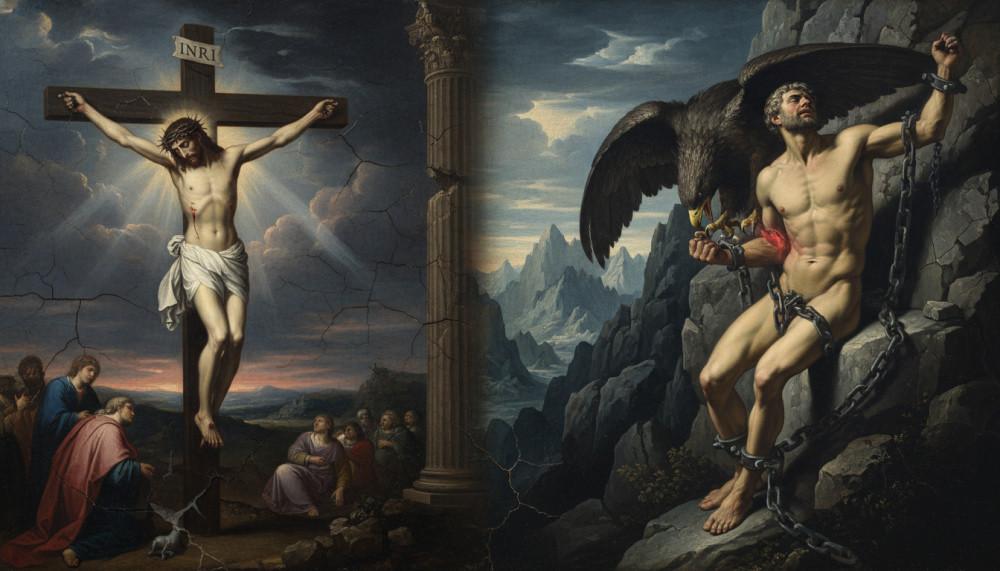
 In the annals of mythology and theology, there exists a resonant archetype: the figure who descends from the transcendent realm to emancipate humanity from the darkness of ignorance, only to suffer agonizing punishment by the ruling powers of the age. While the Greeks looked to Prometheus, the titan who defied Olympus, the Christian looks to Jesus, the Incarnation of the Logos. From a Logocentric perspective—where God is understood as the ultimate Source of logic, truth, and reason—these two figures share a profound narrative symmetry. However, to truly understand the mission of Christ, we must analyze where the myth of the titan ends and the reality of the Logos begins, specifically regarding the “fire” that was brought to earth.
To understand the stakes of this cosmic drama, we must look to the ancient definitions of the protagonists. The myth tells of two titan brothers entrusted with the creation and preservation of mankind: Prometheus, whose name signifies “forethought,” and Epimetheus, meaning “afterthought.” Prometheus, defying the tyrant god Zeus, stole fire from the heavens to give humanity agency, technology, and civilization. Yet, this fire represented more than mere survival; it was the theft of reason itself—specifically the creative power of abductive reasoning. This divine spark gave man the capacity to leap beyond rote compliance, to infer hidden causes, and to conceptually construct a future before it manifests.
From a Logocentric Christian view, this “abductive reasoning” is not merely a cognitive tool; it is the imprint of the Divine mind upon the human soul. It is the mechanism by which we align with objective reality (truth). When Jesus began his ministry, He did not bring a physical flame, but rather the Spirit of truth. He taught humanity to look beyond the “letter of the law” (rote compliance) to the “spirit of the law” (hidden causes and moral intent). By empowering individuals to discern truth for themselves, rather than relying on the gatekeepers of the Sanhedrin or the might of Rome, Jesus was engaging in a Promethean act of liberating human consciousness.
The parallel continues to the ultimate consequence of this liberation: the Passion. In the Greek myth, Zeus, the jealous hoarder of power, punishes Prometheus by binding him to a rock where an eagle eats his liver daily. In the Gospel, the religious and political authorities—who relied on mass ignorance and blind obedience to maintain control—conspired to nail Jesus to the cross. Here, the crucifixion can be viewed as a Promethean punishment. It was the penalty exacted by the “princes of this world” upon the One who dared to give humanity the “divine spark” of independent reasoning. By granting man the ability to reason abductively, Jesus made men ungovernable by tyrants, for a man who can infer the truth needs no king to dictate his reality.
However, the Logocentric framework demands we distinguish between the nature of the “theft” and the nature of the “gift,” while recognizing a deeper alignment in the opposition faced. Prometheus had to steal fire because Zeus was a tyrant who wished to keep humanity in the dark—a figure who, in this discussion, can be seen as analogous to the Devil, the “god of this world” who blinds minds to truth. In parallel, Jesus acted directly against this satanic kingdom by bestowing the Logos upon mankind, the fire of abductive reason that exposes lies and restores divine order. The God of the Logocentric Christian is not a jealous Zeus fearing human potential, but a Creator who desires His creation to mature into co-creators. Jesus did not seize power from the Father to give to man; He revealed that the Father had always intended for man to possess the Kingdom of Heaven (the domain of truth and Liberty). The conflict was not between Jesus and God, but between Jesus and the corrupt systems of control upheld by the god of this age.
This distinction highlights the difference between rebellion and restoration, yet both defy the same adversarial throne. Prometheus is the eternal rebel, defining himself in opposition to the tyrant’s authority. Jesus is the restorer, defining Himself as the incarnation of the ultimate authority—Logos/logic itself—while dismantling the devilish counterfeit. When Jesus violated the Sabbath to heal a withered hand, He used abductive reasoning to demonstrate that the moral law (love/life) supersedes the ritual law. He was not breaking the law for the sake of chaos; He was fulfilling the law by restoring its logical consistency. He showed that true morality is objective and rational, not arbitrary and authoritarian.
We must also consider the brother of Prometheus: Epimetheus, or “Afterthought.” Epimetheus represents the state of humanity in the Fall—reactionary, lacking foresight, and governed by impulse rather than reason. It is Epimetheus who accepts Pandora, unleashing suffering upon the world. A Logocentric philosophy recognizes that sin is essentially “Epimethean”—it is a failure of reason, an inability to foresee the consequences of violating the non-aggression principle, the law of non-contradiction, or natural law (cause and effect). Jesus, as the ultimate “Forethought,” invites us to abandon the reactionary existence of the animal and step into the proactive, reasoning existence of the spiritual being.
The “fire” of abductive reasoning is dangerous to any system built on lies, whether pagan Olympus or the principalities of darkness. It allows the individual to hypothesize a better world and then act to create it. This is the essence of faith—not blind belief, but the “substance of things hoped for, the evidence of things not seen.” It is the logical projection of a future reality based on the understanding of present principles. By granting this power to the meek and the poor, Jesus democratized the divine power of creation. The cross was the attempt by the status quo—and its spiritual overlords—to extinguish this fire, to prove that the cost of reason is death.
Yet, the narrative arc between the titan and the Christ diverges definitively at the resurrection, offering a crucial paradigm for the faithful. While the myth leaves Prometheus bound to the rock—a symbol of the ‘god of this world’s’ relentless crushing of dissent—the Gospel reveals that the Logos breaks the bonds of death. For those who exercise Socratic humility and rely on abductive reason, the daily lived experience often mirrors the Promethean fate: they are metaphorically crucified and devoured when they attempt to introduce reason into their families, workplaces, or governments. Standing for one’s natural rights against the zeitgeist also invites the wrath of the system. However, unlike the titan’s eternal torment, the Christian’s suffering is not a finalized state but a necessary precursor to achieving wisdom. The Logocentric view posits that while truth may be crucified by the agents of entropy, it cannot be killed; thus, the Logocentric Christian’s struggle is not a tragedy of perpetual defeat, but a participation in the inevitable victory of the Divine mind.
Ultimately, to be a Logocentric Christian is to accept the Promethean burden that Jesus carried against the satanic order. It is to wield the divine spark of reason as a weapon against the blindness of the age, rejecting the comfort of “afterthought” and blind obedience, even amid repeated metaphorical crucifixions. We are called to use abductive reasoning to discern truth, to stand firm when the powers threaten punishment for our agency, knowing that the true King has already disarmed them through the Cross and resurrection. The fire has been given; the ability to reason is our birthright. The question remains whether we will let that fire burn out in the winds of conformity, or whether we will tend it until it illuminates the world.
Did you enjoy the article? Show your appreciation and buy me a coffee:
Bitcoin: bc1qmevs7evjxx2f3asapytt8jv8vt0et5q0tkct32
Doge: DBLkU7R4fd9VsMKimi7X8EtMnDJPUdnWrZ
XRP: r4pwVyTu2UwpcM7ZXavt98AgFXRLre52aj
MATIC: 0xEf62e7C4Eaf72504de70f28CDf43D1b382c8263F
THE UNITY PROCESS: I’ve created an integrative methodology called the Unity Process, which combines the philosophy of Natural Law, the Trivium Method, Socratic Questioning, Jungian shadow work, and Meridian Tapping—into an easy to use system that allows people to process their emotional upsets, work through trauma, correct poor thinking, discover meaning, set healthy boundaries, refine their viewpoints, and to achieve a positive focus. Read my philosophical treatise, “The Logocentric Christian”, to learn more about how Greek philosophy, the law of identity, the law of non-contradiction, the law of reason, and Jesus of Nazareth all connect together.
