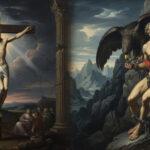
The Fire and the Cross: A Logocentric Examination of the Promethean Christ

In the annals of mythology and theology, there exists a resonant archetype: the figure who descends from the transcendent realm to emancipate humanity from the darkness of ignorance, only to suffer agonizing punishment by the ruling powers of the age. While the Greeks looked to Prometheus, the titan who defied Olympus, the Christian looks to Jesus, the Incarnation of the Logos. From a Logocentric perspective—where God is understood as the […] Read more »

Stop Opening Pandora’s Jar: Forging Awareness Through Multilogical Forethought

In my previous examination of Pandora’s Jar, I dismantled the deceptive comfort of hope, exposing it as a passive tether that binds us to the reactive cycle of afterthought. To break free from this paralysis, one must adopt the mantle of Prometheus—the bringer of forethought. However, true forethought is not merely the intellectual exercise of predicting outcomes; it is an act of rigorous, spiritual, and cognitive alignment with reality, or the Logos. […] Read more »

Pandora’s Jar and the Curse of Hope

Forethought, Afterthought, and the Trap of Passive Hope To live in alignment with the Logos—the divine ordering principle of truth—requires a rigorous devotion to cause and effect. It demands that we look at reality not as we wish it to be, but as it objectively is. However, the human mind is frequently divided between two modes of being: the active will of the planner and the passive reaction of the […] Read more »

Reclaiming the Power of the Christian Mythos

Moving from religious conformity to internalized wisdom Humanity’s search for meaning has long been channeled through the great edifices of organized religion. These systems offer structure, community, and a framework for morality, promising a guiding light in a complex world. Yet, for countless individuals, that promised light can feel more like a cage. When institutions demand adherence to rigid, unchallengeable doctrines, they cease to be tools for liberation and instead […] Read more »

Prometheus, Epimetheus, Stolen Fire, & Pandora’s Box

The mind is an attribute of the individual. There is no such thing as a collective brain. There is no such thing as a collective thought. An agreement reached by a group of men is only a compromise or an average drawn upon many individual thoughts. It is a secondary consequence. The primary act—the process of reason—must be performed by each man alone. We can divide a meal among many […] Read more »

Duality, the Garden of Eden, and Ayn Rand

In the biblical narrative, duality emerges as a consequence of humanity’s choice to eat from the Tree of the Knowledge of Good and Evil, an act framed by me as providing the necessary “opt-out” from a higher harmony and morality, to ensure free will. Eating the “forbidden fruit” plunges existence into a polarized state, where good and evil are no longer integrated within a unified moral framework but are instead […] Read more »