 Ken Wilber’s pre/trans fallacy identifies a cognitive error where individuals mistake primitive, pre-rational states for advanced, trans-rational spiritual realization simply because both exist outside the rigid structure of conventional rationality. This developmental spectrum progresses from the pre-rational stage of subconscious instinct and undifferentiated emotion, through the rational stage of logic, boundaries, and objective law, and finally to the trans-rational stage of superconscious integration and sovereignty. A prime example of this confusion occurs in certain New Age circles, where a guru’s lack of discipline, logical incoherence, and narcissistic emotional bypassing are elevated and championed as “enlightenment,” effectively mistaking a regression to infantile behavior for an ascension to divine wisdom.
Ken Wilber’s concept of the pre/trans fallacy offers a profound lens through which we can understand the destructive mechanics of possessiveness, jealousy, and envy. The fallacy suggests that people often confuse pre-rational states (instinctive, impulsive, narcissistic) with trans-rational states (spiritual, integrated, enlightened) simply because both are non-rational. When we apply this to interpersonal dynamics and spiritual maturity, we see that controlling behavior is not an act of strength, but a pre-rational regression. The jealous individual often desires the “trans” state of perfect union or abundance but lacks the internal scaffolding to achieve it. Instead of doing the necessary work to rise through the rational stage of learning and earning, they regress to the pre-rational use of force, attempting to bypass Natural Law to seize what they have not become.
This bypassing mechanism is rooted in a fundamental misunderstanding of how reality operates under the Logos. The rational stage of development requires us to understand cause and effect, to respect boundaries, and to acknowledge that to “have” something, one must first be aligned with the Truth of it. However, the envious or controlling person attempts to skip this crucial developmental step. They perceive the desirable outcome—a loyal partner, social status, spiritual peace—but instead of learning how to embody the qualities that naturally attract these things, they attempt to simulate the result through coercion. They try to jump from the basement to the penthouse without climbing the stairs, and inevitably, they fall.
At the heart of this behavior lies a deep-seated sense of unworthiness. The most controlling individuals are paradoxically the most powerless, for true power is an internal state of being that requires no external enforcement. When a person does not feel worthy of love or success, they cannot conceive of a reality where these things flow to them naturally. Because they do not possess the “kingdom within,” they frantically attempt to construct a fortress without. They are driven by a fear that if they release their grip, their lack of internal substance will be exposed, and they will be left with nothing. Thus, control becomes a crude substitute for competence, and possession becomes a poor substitute for connection.
Consider the stereotype of the jealous boyfriend who isolates his partner, forbidding her from seeing friends or leaving the house. In his mind, he is securing the relationship, perhaps even convincing himself he is protecting a “sacred union” (a pseudo-trans rationalization). In reality, he is operating from a pre-rational, animalistic drive to hoard resources. He lacks the rational capacity to build a mutual relationship where both parties flourish in freedom. He does not know how to *be* the kind of man who naturally inspires loyalty; therefore, he must use force to ensure she has no other options. He destroys the very thing he seeks—love—because love acts in freedom, and control is the negation of freedom.
The biblical narrative of Cain and Abel serves as the primordial example of this dynamic. Cain’s offering was rejected not out of divine caprice, but because it lacked the proper internal orientation—it was not aligned with the Logos, or the “right way” of being. Instead of engaging the rational faculty to ask, “How can I improve my offering? How can I align myself with the Truth as my brother has?” Cain slipped into the pre-rational fugue of envy. He sought to eliminate the reflection of his own inadequacy by destroying Abel, falsely believing that if he extinguished the rival, God would be forced to validate him as the only remaining option. Cain believed that by removing the competition, he would secure the blessing. But under Natural Law, one cannot kill their way to favor; the external act of violence could never compensate for the internal lack of alignment.
This brings us to the crucial distinction between “wanting” and “having,” a dynamic that dictates the trajectory of our souls. As discussed in previous writings on the “Wanting, Having, and the Two Games,” wanting and having are mutually exclusive states. To “want” is to affirm to reality, “I do not have.” It is a declaration of scarcity that generates a feedback loop of lack, leading to lust and greed—the desire to consume what is outside oneself. To “have,” conversely, is a state of being. It is the realization of abundance where one generates value from the inside out. The controlling person is stuck in the game of “wanting.” They are empty vessels trying to fill themselves by stealing from the world, unaware that the only way to be full is to become a fountain. This state of wanting is reminiscent of Carl Jung’s description of the “evil one” in his Red Book:
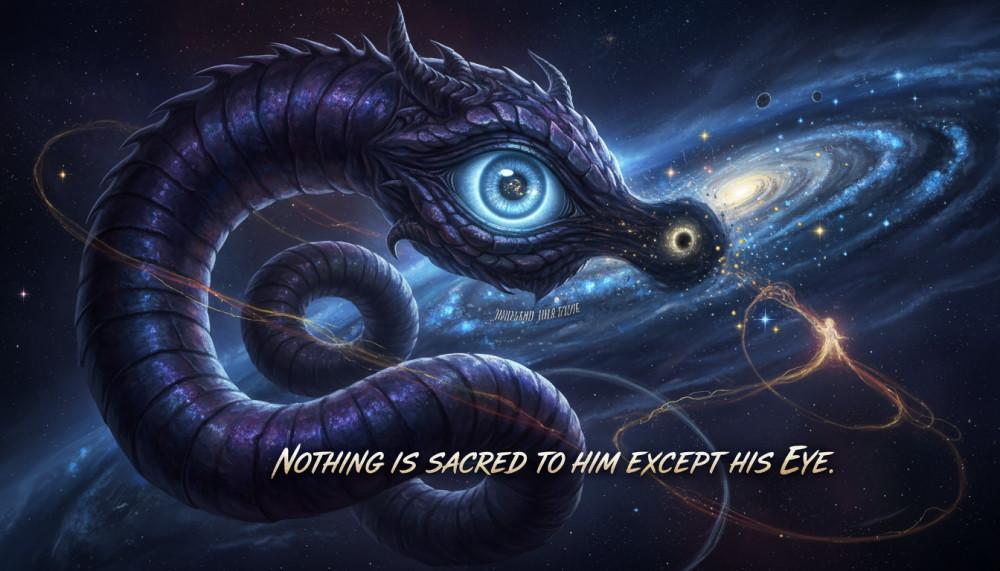
Nothing is more valuable to the evil one than his eye, since only through his eye can emptiness seize gleaming fullness.
Because the emptiness lacks fullness, it craves fullness and its shining power. And it drinks it in by means of its eye, which is able to grasp the beauty and unsullied radiance of fullness.
The emptiness is poor, and if it lacked its eye it would be hopeless.
It sees the most beautiful and wants to devour it in order to spoil it.
The devil knows what is beautiful, and hence he is the shadow of beauty and follows it everywhere, awaiting the moment when the beautiful, writhing great with child, seeks to give life to the God.
If your beauty grows, the dreadful worm will also creep up you, waiting for its prey.
Nothing is sacred to him except his eye, with which he sees the most beautiful.
He will never give up his eye. He is invulnerable, but nothing protects his eye; it is delicate and clear, adept at drinking in the eternal light. It wants you, the bright red light of your life.
~Carl Jung, The Red Book, Hell, Page 289
Logocentric Christianity teaches us that the external world is a reflection of the internal state. “As within, so without.” Therefore, to be jealous is to admit that one has not integrated the Truth. Those who understand the Logos—the divine logic that orders the cosmos—know that you cannot cheat reality. If you are truly abundant, you do not fear loss. If you are truly loving, you do not fear abandonment. The man who embodies the Truth does not get angry when others succeed; he recognizes that their success is a testament to the same Natural Laws he himself follows. He has no need for envy because he possesses the roadmap to the infinite; he knows how to generate his own offering.
The pre/trans fallacy in this context is the delusion that one can achieve the “trans” state of god-like authority through the “pre” state of brute force. It is the Luciferian error: attempting to seize the throne of God without undergoing the necessary alignment with the Logos. True spiritual authority—the “trans” state—is characterized by sovereign self-completeness and the radiation of abundance. It is not a negation of the self, but the ultimate realization of the self under God, where one no longer needs to extract energy from others because they have become a generator of value. It is the power that commands the wind and waves not by shouting, but by the sheer weight of its alignment with the Father. The controlling ego simulates this authority but relies on fear and manipulation, which are the tools of the spiritually bankrupt.
This reliance on control reveals a fundamental fracture in the soul, manifesting as what Logocentric philosophy defines as the performative contradiction of aggression. Fundamentally, aggression is the desperate attempt to obtain a value that one did not create and did not earn. When the envious individual initiates force—whether through physical restriction, emotional manipulation, or the theft of value—to possess what is not theirs, they enter a state of internal incoherence. By aggressing against another, they implicitly claim a right of ownership over that person’s will or property, yet by that very act of violation, they deny the universal principle of self-ownership itself. This is not merely a moral failing but a logical error; it is an attempt to exist in direct opposition to the Logos. One cannot build a valid reality on a contradiction, and thus, the aggressor is perpetually at war with their own existence, severing their connection to the Source of true power and ensuring that they can never truly “have” what they seek to capture.
To escape this trap, we must embrace the rational/ethical stage as the necessary bridge to the trans-rational. We must submit to the discipline of the Logos. This means accepting objective morality and the reality of Natural Law. We must learn the skills of relationship, the discipline of character, and the patience of faith. We must understand that we cannot force a harvest where we have not sown seeds, and we cannot demand a loyalty we have not earned. We must move from the “pre” mindset of “I want, so I take” to the “rational” mindset of “I sow, so I reap,” so that we may eventually reach the “trans” reality of “I am, and therefore it is.”
In the end, the cessation of jealousy and control comes only with the acceptance of the Truth. When we align our psyche with the Logos, we stop trying to manipulate the external screen of reality and start changing the internal projector. We realize that the Kingdom of God is not a territory to be conquered by force, but a frequency to be tuned into by righteousness. Those who are “far gone” in envy are simply those who have forgotten—or never learned—that they are the authors of their own experience, and not manipulators of their own experience. By releasing the need to control, we finally gain the capacity to receive, moving from the poverty of force to the abundance of true internalized power.
Did you enjoy the article? Show your appreciation and buy me a coffee:
Bitcoin: bc1qmevs7evjxx2f3asapytt8jv8vt0et5q0tkct32
Doge: DBLkU7R4fd9VsMKimi7X8EtMnDJPUdnWrZ
XRP: r4pwVyTu2UwpcM7ZXavt98AgFXRLre52aj
MATIC: 0xEf62e7C4Eaf72504de70f28CDf43D1b382c8263F
THE UNITY PROCESS: I’ve created an integrative methodology called the Unity Process, which combines the philosophy of Natural Law, the Trivium Method, Socratic Questioning, Jungian shadow work, and Meridian Tapping—into an easy to use system that allows people to process their emotional upsets, work through trauma, correct poor thinking, discover meaning, set healthy boundaries, refine their viewpoints, and to achieve a positive focus. Read my philosophical treatise, “The Logocentric Christian”, to learn more about how Greek philosophy, the law of identity, the law of non-contradiction, the law of reason, and Jesus of Nazareth all connect together.

One Response to “Envy’s Logic: How Control Attempts to Bypass Cause and Effect”
Read below or add a comment...
Trackbacks
[…] my previous reflection on the pre/trans fallacy, we explored how individuals attempt to bypass the rational work of character development to seize […]