Mandatory Submission: When Health Becomes the Ultimate Philosophical Fraud
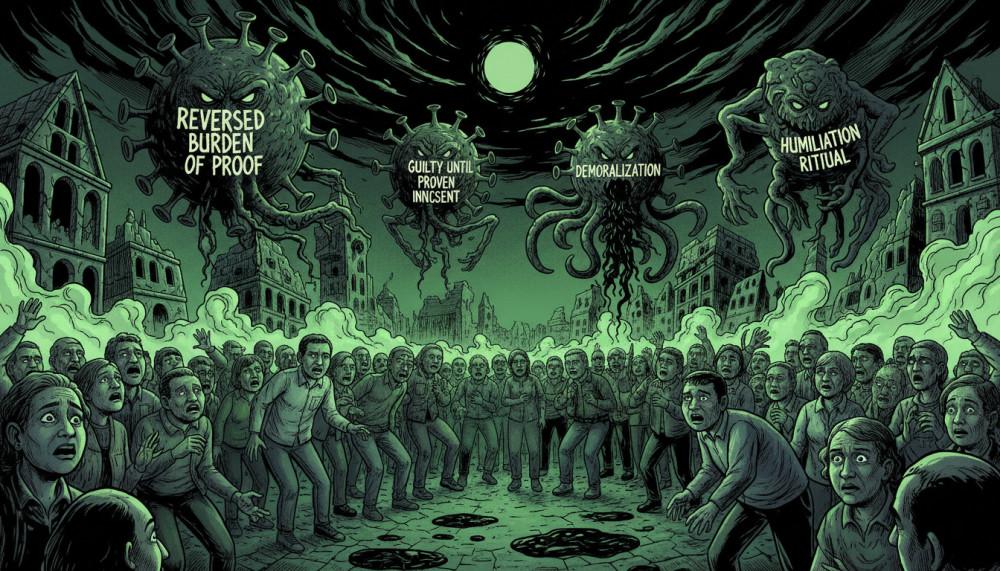
The recent era of biomedical statecraft revealed a deep philosophical and legal crisis that strikes at the foundations of Western liberty. At the heart of this collapse is a subtle but devastating inversion of the burden of proof, an epistemological error weaponized through the political application of germ theory. In any society governed by reason and natural law, a man is presumed healthy until proven sick, and innocent until proven guilty. The modern state, however, fueled by a materialist obsession with an impossible standard of safety, flipped this foundational principle on its head. The citizenry was treated as a collective of biological liabilities, presumed to be a threat until they could demonstrate compliance with state mandates. This is not merely a policy error; it is a fundamental fallacy that transforms free citizens into subjects of a technocratic containment state.
To understand this shift, we must first analyze its chosen instrument: germ theory. In its scientific context, germ theory posits that specific microscopic pathogens are the causative agents of specific diseases. While the model has clinical utility, its political application has been disastrous. By focusing entirely on an external, invisible invader, rather than the sovereign integrity of the individual human system, the state constructs a narrative of perpetual, abstract vulnerability. If the enemy is unseen and omnipresent, then the state’s power to combat it must logically become total and omnipresent. The result is a society paralyzed by the fear of the hypothetical, willing to trade concrete liberties for the illusion of a sterile environment.
This brings us to the core philosophical principle at stake: the burden of proof. In logic and rational discourse, the burden of proof (onus probandi) rests squarely on the party making a positive claim. If the state asserts that a healthy, asymptomatic individual poses a tangible threat to others, the state bears the full responsibility of proving that claim with concrete evidence. In the legal tradition of the West, this is enshrined as the presumption of innocence. One cannot be detained, restricted, or forcibly medicated based on a statistical probability or a hypothetical risk. Yet, the concept of the “asymptomatic carrier” was engineered to demolish this safeguard. The premise of the pandemic response was that every human being was a potential vector of harm, dangerous by default. The burden was thus inverted, shifted to the citizen to prove their non-threatening status through constant testing and, ultimately, vaccination. This is the logic of a police state, where suspicion replaces evidence and everyone is presumed guilty.
The implementation of this “guilty until proven innocent” framework necessitates the violation of personal boundaries. A boundary, in any coherent ethical system, is the line that defines an individual’s autonomy, responsibility, and physical personhood. It establishes self-ownership, communicating the essential distinction between “mine” and “yours.” These are not social conventions but preconditions for a free and functional society. A society that respects the individual understands that each person is the primary agent and steward of their own body and health.
The state sought to dissolve these essential boundaries with the collectivist mantra of “keeping your neighbor safe.” This rhetoric is a manipulative inversion of responsibility. By asserting that my health is your obligation and your health is mine, the state effectively socializes our very bodies, turning them into a public utility. This is a profound boundary violation on a civilizational scale. If I am held responsible for the health of a stranger, then the state, acting as the arbiter of that responsibility, gains a claim on my body and my choices. This mutual liability destroys individual sovereignty and creates a collective where the State acts as the central command, directing the biological functions of its subjects for the “greater good.”
This logic leads inexorably to the demand for mandatory vaccination. When the burden of proof is inverted and individual boundaries are erased, the forced injection becomes the ultimate technocratic ritual of submission. If you are presumed “guilty” of being a potential threat, the only path to restored social standing is through compliance with the state-prescribed medical intervention. This ceases to be about health and becomes an act of political allegiance. It demands that the individual surrender the final boundary—bodily integrity—to the will of the collective. To accept a medical procedure under duress is to concede the philosophical premise that you do not own yourself, that your body is state property to be managed and modified as the state sees fit.
We must reject this false morality with absolute philosophical clarity. A philosophy grounded in reason and individual sovereignty affirms that each person is the sole authority over their own body, with no ethical duty to violate their own boundaries or submit to the violation of those boundaries for the sake of another’s unproven fears. We do not owe an abstract “public” the sacrifice of our bodily autonomy. The person demanding you alter your body to manage their anxiety has abdicated their own responsibility to govern their fears. They are projecting their existential dread onto you, demanding you serve as a shield against the uncertainties of life.
The myth of the “proposition nation”—the notion that a nation is merely a set of abstract ideas—crumbled under the weight of this biological tyranny. It revealed the weakness of a society unmoored from concrete traditions and a shared understanding of liberty when confronted by the powerful, totalizing logic of safetyism. The state used the public health crisis to accelerate the atomization of the populace, isolating individuals, masking their faces to obscure their humanity, and enforcing a compliance that humiliates the spirit of a free people.
This strategy of social control has a dark and well-documented pedigree, drawn directly from the playbook of 20th-century totalitarianism. The state’s use of the public health crisis to atomize the populace, isolate individuals, mask their faces, and enforce a compliance that humiliates the spirit is not novel. It is a classic application of demoralization, a tactic perfected by communist states whose primary goal was not to persuade the public of an ideology’s merits, but to force the public to become complicit in its lies. The objective is to break the individual’s connection to reality and, by extension, their moral will to resist.
Aleksandr Solzhenitsyn observed that the power of a totalitarian state rests on the population’s participation in the “official lie.” The lie need not be sophisticated or even believable; in fact, its very absurdity serves the purpose. When a man is forced to repeat a slogan he knows is false, or perform a ritual he knows is meaningless, his integrity is compromised. He is forced to live a contradiction, and this internal division makes him weak. The “pandemic” provided a masterclass in this technique. The ever-shifting narratives—masks are useless, masks are mandatory; lockdowns for two weeks, lockdowns for two years; the vaccine stops transmission, the vaccine merely lessens symptoms—were not a sign of evolving science, but a tool of psychological disorientation. The goal was to destroy the public’s confidence in their own perceptions and critical faculties, making them dependent on the state for their understanding of reality.
Enforced compliance with absurd rituals is the physical manifestation of this strategy. Forcing a citizen to wear a mask while walking alone outdoors, or to don it between bites of food at a restaurant, is not a public health measure; it is a loyalty test. It is a small act of humiliation designed to signal submission to an authority that is openly irrational. Each act of compliance, no matter how small, makes the next, larger act of compliance easier. The individual becomes a participant in the farce, and his complicity creates a psychological barrier to future dissent. To resist later would be to admit that his previous actions were foolish and cowardly—a difficult admission for most.
Furthermore, these tactics are profoundly effective at atomizing a populace. Lockdowns, social distancing mandates, and the shuttering of churches, pubs, and community halls served to sever the horizontal bonds of fellowship that give a people strength. A man who meets with his neighbors, worships with his congregation, or raises a glass with his friends is part of a living community capable of collective action. An individual isolated in his home, receiving all his information through a screen controlled by the state, is powerless. The state becomes his sole point of contact with the world. By framing normal human interaction as a deadly threat, the state transformed neighbors into mutual suspects, a tactic which reverses the social burden of proof by replacing the bonds of trust with the presumption of threat. In this environment of manufactured distrust, solidarity becomes impossible, and the state’s power becomes absolute. The masked, isolated, and demoralized citizen is the perfect subject for a tyranny that governs not by consent, but by the relentless management of fear.
Ultimately, this battle is epistemological: it is about who has the authority to define reality. Does that authority rest with the sovereign individual, employing reason and direct experience, or with a centralized technocratic state that governs through abstract models, statistical projections, and fear? It is a fundamental conflict between a philosophy of liberty and a philosophy of control. When we accept the premise that we are “guilty until proven innocent” of carrying an invisible threat, we have already surrendered the philosophical high ground. We have accepted the lie that we are fundamentally liabilities to one another, rather than sovereign individuals.
Recovery begins with the philosophical re-establishment of boundaries and the principled rejection of the inverted burden of proof. We must declare that our health is our own responsibility, not the state’s and not our neighbor’s. We must affirm that we are free men and women, presumed innocent of any threat until proven otherwise by objective evidence. We must refuse to live by the state’s lie. The hypothetical threat of a pathogen pales in comparison to the real and present threat of a state that claims ultimate ownership over the bodies of its citizens. The first and most powerful act of resistance is to reclaim the sovereignty of the self.
Did you enjoy the article? Show your appreciation and buy me a coffee:
Bitcoin: bc1qmevs7evjxx2f3asapytt8jv8vt0et5q0tkct32
Doge: DBLkU7R4fd9VsMKimi7X8EtMnDJPUdnWrZ
XRP: r4pwVyTu2UwpcM7ZXavt98AgFXRLre52aj
POL: 0xEf62e7C4Eaf72504de70f28CDf43D1b382c8263F
THE UNITY PROCESS: I’ve created an integrative methodology called the Unity Process, which combines the philosophy of Natural Law, the Trivium Method, Socratic Questioning, Jungian shadow work, and Meridian Tapping—into an easy to use system that allows people to process their emotional upsets, work through trauma, correct poor thinking, discover meaning, set healthy boundaries, refine their viewpoints, and to achieve a positive focus. Read my philosophical treatise, “The Logocentric Christian”, to learn more about how Greek philosophy, the law of identity, the law of non-contradiction, the law of reason, and Jesus of Nazareth all connect together.

One Response to “A Logocentric Philosophical Perspective on the 2020 Pandemic”
Read below or add a comment...
Trackbacks
[…] As I analyzed during the height of the lockdowns, Aleksandr Solzhenitsyn observed that the power of a totalitarian structure relies entirely on the population’s participation in the lie. The pandemic provided a masterclass in this psychological conditioning. By enforcing compliance with absurd rituals—masks that changed function based on political necessity, lockdowns that defied logic—the state weakened the individual’s integrity. The goal was to fracture the public’s confidence in their own perceptions, making them dependent on external authority for their understanding of reality. This was the conditioning phase: breaking the will through disorientation. […]