The Logocentric Christian: A Philosophical Treatise on Reason, Character, Sovereignty, and Value

Introduction: A Philosophical Inquiry Let it be stated from the outset: what follows is a philosophical treatise, not a theological one. Logocentric Christianity, as it will be detailed, is not a new set of doctrines to be accepted on faith, but a rational framework for understanding reality, morality, and the human condition. It is an operating system for the mind, grounded in the primacy of the Logos—the universal principle of […] Read more »

The Sovereign Opt-Out

Atlas Shrugged meets Peter Pan meets a Logocentric Christianity The great departure was not an ending, but a thinning. It was a quiet exodus, unnoticed by those who measured the world in headlines and polls. There was no rupture in the sky, no grand announcement, only a gradual and persistent vanishing of certain individuals. They were the chess players in a world that had embraced Calvinball, the architects in an […] Read more »

The Captain of the Soul: Why a Principled Ego Is the Bedrock of True Individuality

Can individuality, individualism, or individuation exist without the ego? Individualism, from a Randian perspective, is the moral stance that man’s primary moral purpose is the pursuit of his own rational self-interest and happiness through the unfettered use of his reason. It holds that a man must exist for his own sake, neither sacrificing himself to others nor sacrificing others to himself. In the modern search for meaning, the ego has […] Read more »

The Architecture of Reality: Mastering our Inner World to Create our Outer World

The All is mind; the Universe is mental. ~The First Hermetic Principle – Mentalism, The Kybalion The proposition that human thought is creative stands as a profound psychological and philosophical truth. What you think, you become. The ideas you permit to inhabit your mind are the architectural blueprints for the reality of your life, with effects that ripple out into the world. Every action is born from a thought, every […] Read more »

Is Pride a Deadly Sin, or a Necessary Virtue?

Pride in one’s past means taking credit for one’s specific achievements, pausing to recognize oneself with either “I did it,” or “This is good.” It means taking credit, as a self-made being, for simply being who one is. This includes taking credit for one’s accomplishments of character and personal development. […] The two perspectives of pride in the past and pride in the future are inseparable, because one cannot achieve […] Read more »

Character as the New Standard of Judgment

Most conceptions of divine judgment, such as is found through a superficial reading of Revelation 20:11-15, fixate on actions as the primary subject of evaluation, treating deeds as isolated transactions to be weighed. Yet this perspective fundamentally misunderstands causality: actions are mere effects, outward manifestations of an inner landscape of character, belief and willful focus. While external forces—genetics, upbringing, cultural conditioning—shape this terrain, they never erase the sovereign space of […] Read more »

The Metaphysics of Creating Your Own Reality: Focus, Schrödinger’s Cat, Mystery Boxes, the Rapture, and Timeline Jumping

From a psychological perspective, the idea that “focus creates one’s reality” suggests that an individual’s attention and cognitive prioritization shape their perception and experience of the world by filtering sensory information and amplifying what aligns with their focus. This process, often linked to mechanisms like the brain’s reticular activating system, influences beliefs, emotions, and behaviors, effectively constructing a subjective reality based on where one directs their mental energy. The principle […] Read more »

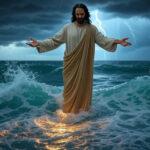
Jesus Walking on Water: A Metaphor for Neutralizing Life’s Storms

22 Immediately Jesus made the disciples get into the boat and go on ahead of him to the other side, while he dismissed the crowd. 23 After he had dismissed them, he went up on a mountainside by himself to pray. Later that night, he was there alone, 24 and the boat was already a considerable distance from land, buffeted by the waves because the wind was against it. 25 Shortly before dawn Jesus went out […] Read more »

The Core of Individualism: Humility, Empathy, and Courage

Intellectual Humility: Having a consciousness of the limits of one’s knowledge, including a sensitivity to circumstances in which one’s native egocentrism is likely to function self-deceptively; sensitivity to bias, prejudice and limitations of one’s viewpoint. Intellectual humility depends on recognizing that one should not claim more than one actually knows. It does not imply spinelessness or submissiveness. It implies the lack of intellectual pretentiousness, boastfulness, or conceit, combined with insight […] Read more »

Transcending the Veil: Depth, Trauma, and the Expansive Consciousness

Transactional Love is a conditional exchange where affection or care is offered with the expectation of receiving something in return, such as validation or reciprocation. It operates like a contract, driven by external motives and often tied to a sense of obligation or debt. Non-Transactional Love is given freely without expecting repayment, rooted in genuine care and intrinsic motivation. It prioritizes authentic connection and truth, unbound by calculations or external rewards. The […] Read more »

Missing the Mark: The Vibratory Disconnect in Logocentric Speech

Cymatics is the study of how sound vibrations create visible geometric patterns in physical mediums like sand, water, or powder, revealing the impact of specific frequencies. These patterns demonstrate the organizing power of vibrational energy, showing how vibration can shape matter into intricate, orderly forms. Spontaneous order refers to the natural emergence of organized patterns, structures, or behaviors in complex systems without centralized planning or control, driven by the interactions […] Read more »

Breaking the Matrix: How Abductive Reasoning Unites Reality and Truth

Deductive reasoning, defined as starting with general premises assumed true and deriving specific conclusions—like “all dissenters disrupt order, so Jane, a dissenter, is disruptive”—often shapes how people perceive reality, mistaking their subjective lens for universal truth. This process can create a thought matrix, a rigid mental framework where premises from culture, authority, or personal experience dictate thought’s boundaries, defended dogmatically as reality itself. For example, someone shaped by childhood trauma […] Read more »

The Metaphysics of Narcissism: Stealing Innocence & the Emperor’s New Clothes

The Genesis account of Adam and Eve in the Garden of Eden provides a foundational narrative for understanding the loss of innocence, particularly in the moment when they sew fig leaves to cover themselves after eating from the Tree of Knowledge of Good and Evil (Genesis 3:7). Before this act, their nakedness carried no shame (Genesis 2:25), suggesting that their innocence functioned as a natural garment, a state of unselfconscious […] Read more »

Boundaries & Affirmations for Channeling the “Other Side”

It is really easy to figure out lies here in this world through the use of logic, verifying evidence, examining the philosophy of something, and cross referencing it with morality, however, it is far more difficult to use such skills when speaking to beings on the other side of the veil, because we really just can’t verify how things actually are over there due to our inability to verify it […] Read more »

How to Bend Reality to Your Will and Become Unstoppable | Moran Cerf on Impact Theory

This is an interesting discussion on free will. Hint, you get more of it the more you know yourself, and understand why you think, feel, and behave as you do. We break free from nature and nurture’s environmental variables through getting to know ourselves, and asserting our will upon what we observe about ourselves, so that we can tweak our focus to reach our full potential. There was something Moran […] Read more »